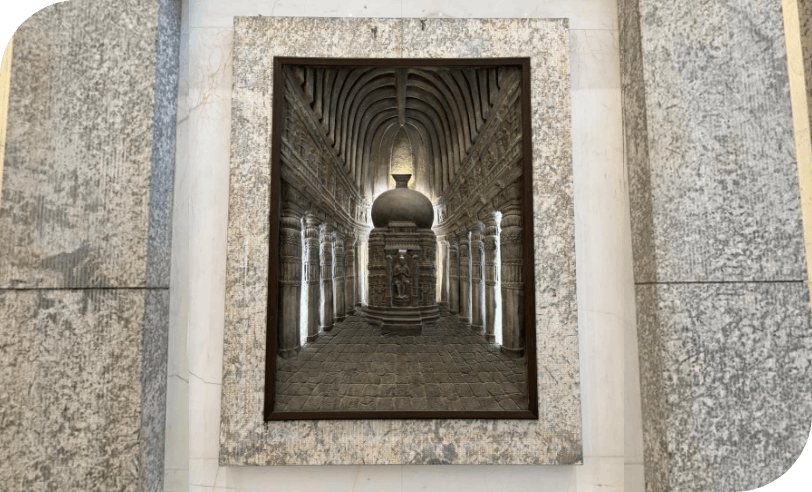
Ajanta And Ellora Caves
Aurangabad, Maharashtra, 2nd Century BCE – 10th Century CE
The Ajanta and Ellora Caves stand as extraordinary achievements of ancient Indian architecture and engineering, carved entirely from solid basalt rock using the rock-cut technique. Unlike built structures, these monuments were executed through a top-down excavation method, demanding precise planning, structural foresight, and exceptional craftsmanship.
From an architectural standpoint, the caves demonstrate advanced understanding of spatial planning, proportion, symmetry, and acoustics. Ajanta’s chaityas and viharas reflect early Buddhist monastic design, with carefully aligned columns, ribbed ceilings, and natural light modulation. Ellora expands this mastery across Buddhist, Hindu, and Jain traditions, culminating in the Kailasa Temple—an engineering marvel carved from a single rock mass, showcasing complex multi-level geometry and monumental scale.
Engineering brilliance is evident in the caves’ structural stability, water drainage systems, and longevity. Artisans anticipated load distribution, rock fractures, and erosion, ensuring durability over centuries without modern tools. The seamless integration of architecture, sculpture, and engineering reveals a deep scientific understanding of material behavior and construction sequencing.
Together, Ajanta and Ellora represent timeless benchmarks of sustainable construction, structural intelligence, and artistic precision—where engineering served not just function, but spiritual and cultural expression carved permanently into stone.